Our Mission Statement

Our Mission Statement: To deliver consistent, ongoing and valuable information to clients to make them intelligent and educated real estate wise.

Sunday, July 17, 2016

Rarely Offered End Unit Condo Townhouse in Markham!

SOLD for over the Asking Price


  • Upgraded gleaming hardwood floors throughout!
  • Extra windows to fill the living & dining room, plus kitchen with sunlight
  • The convenience of two (2) full bathrooms
  • Great open concept for entertaining with w/o directly to your unshared deck
  • Ready for those outdoor summer parties
  • Upgraded quartz counter
For more pictures and information: Click here


Tuesday, July 12, 2016

Reasons to use a Realtor when buying a pre-construction condo!

Excerpted from The Toronto Sun
Pre-construction condos: Should you use a realtor?
Stephen Moranis, Special to Postmedia Network
 

First posted:
 Aura condominium Should you use a realtor when buying a new pre-construction condo?
The answer for this is a definite YES. Toronto realtor Matt Smith, who specializes in helping buyers navigate through the complicated process of buying new condos, has shared with me the many pitfalls and disadvantages of buyers going it alone when dealing with the builders’ sales staff.
Above all else, realize that the builder’s sales team works for the builder and only the builder. That is where their loyalties lie. They simply have zero interest in protecting you or your rights, or in getting you the best deal or best location within the building. By using your own real estate agent, you get the advantages of comparative shopping as well as their specialized knowledge of these complicated transactions, which can potentially save you both legal and financial problems and surprises down the road. It is important to declare and introduce your realtor with the builder when you register as a client at the new condo site.
Here are twelve ways a realtor can help you through the process:
  • Your realtor can gain you access to VIP events. This is where the best prices and floor plans are available for sale. By the time the building goes to public market, often the choice units have been sold with up to 50% of the units being taken before the general public gets to pick any suites. VIP realtor events help you get better suites and prices.
  • Your realtor knows how to ask the right questions – and many you don’t know to ask.
  • Your realtor can guide you through the important steps during the 10 days of the Cooling Off Period. Skipping these steps can create problems.
  • Your realtor can help negotiate the agreement in your best interest. Many things are negotiable and your experienced agent can help you navigate through this process.
  • Your realtor has access to MLS. This is important for pricing advice so that you can compare both new and resale properties and be better informed on what is a fair price.
  • Your realtor can explain the importance of “The Right To Assign.“ Once the property is constructed there is interim occupancy then there is registration. You as a new buyer may want to assign (sell your rights) your agreement at any time during this lengthy period and you may be just selling your paper. The purchase agreement must spell out the fees and conditions for this privilege so that you know these well in advance. Many builders will deny this right and you should know this before you buy.
  • Your realtor understands how to read the building plans. It is important to know where the garbage chute, elevators and stairwells are, as well as your underground parking space, storage locker and additional amenities such as the pool, party room and gym.
  • Your realtor has a good general understanding of the neighbourhood and any potential new developments that could restrict your views later on and cause traffic issues.
  • Your realtor can help you coordinate all of the closing costs and details with your lawyer.
  • Your realtor can explain how the HST will affect your closing costs and can help determine whether you are eligible for any HST rebates on your purchase.
  • Your realtor can explain to you how the interim occupancy costs work, and more importantly, how the builder calculates these charges.
  • Your realtor can explain with you the changing reality of your monthly condo fees. The builder generally underestimates these fees for a variety of reasons, and you should be aware that the fees that may be quoted can escalate and sometimes very dramatically in the first few years. You probably should budget for increases of somewhere between 10 and 20%, though many actual condo fees have gone up significantly more than that.
  • The expert advice of a knowledgeable realtor can save you tens of thousands of dollars on a pre-construction condominium. They can help you negotiate everything from upgrades to a cap on your development closing costs, which can be significantly more than a resale condo. The builder has also built in the fees to the buyer’s agent – in fact, they do not reduce the purchase price if you don’t use one. This transaction has so many nuances and subtleties that it is definitely worthwhile to get the help of an experienced professional.
Stephen Moranis, B.Comm., MBA, FRI, CMR has been active in the North American Real Estate Industry for more than 40 years. He is a former President of the Toronto Real Estate Board and a former Director of the Canadian Real Estate Association.                                                                                                                                                                                             tower in Toronto. (Ernest Doroszuk/Toronto Sun)
File photo of the construction site for the Aura condominium


Sunday, June 5, 2016

The best argument to buy a home in Canada- It's A Proven Performer!

5 Reasons You Should Buy A Home In 2016


Posted: Updated:
    

REAL ESTATE

Written by Wayne Karl
Why is 2016 a good year to buy a home in Canada? Let us count the ways.

1. LOW INTEREST RATES
In its latest rate announcement on Jan. 20, the Bank of Canada held its target for the overnight rate at 0.50 per cent, citing a setback brought on by a decline in oil and commodities prices. BoC expects the economy to grow by about 1.5 per cent in 2016 and 2.5 per cent in 2017.
Some experts, such as Benjamin Tal, deputy chief economist at CIBC World Markets, expects interest rates to remain low through 2016, if not fall.
At least one lender, in Ontario, even recently introduced what it says is the lowest posted fixed mortgage rate on the market - at 1.69 per cent for a one-year term.
The BoC's next rate announcement is March 9.
2. THE UPSIDE OF DOWN PRICES
When the The Canadian Real Estate Association (CREA) released its latest statistics on Feb. 16, one number jumped off the page and into the headlines: 17 per cent - the rate by which the national average sale price rose on a year-over-year basis in January.
"Holy," prospective homebuyers might have thought, "how will I ever be able to buy a home if this keeps happening?"
The key thing to look for when you see such news, however, is what's happening in your market. Real estate is local, not national. You don't buy the Canadian market, or even a provincial or regional one. You buy one home in one location.
Excluding British Columbia and Ontario from CREA's January stats, the national average sale price actually declined slightly, by 0.3 per cent.
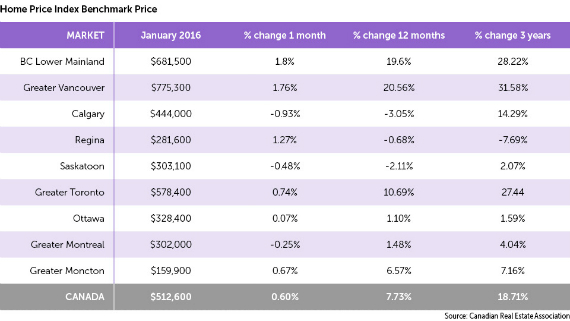
Economies and housing sectors in markets such as Calgary, Edmonton and Saskatoon are feeling the pinch of the extended slowdown in oil and gas. For existing homeowners, of course, this isn't great news; average home prices in Calgary dropped 3.05 per cent year-over-year in January, and in Saskatoon they fell 2.11 per cent.
For prospective buyers, however, this means opportunity.
Naturally, buyers might not too jazzed about getting in when prices are dropping, fearing their home's value will go down after they purchase. But look at the longer term. In Calgary, prices have increased 14.29 per cent over the last three years; in Saskatoon, 2.07 per cent.
2016-02-29-1456714515-3580277-HomePriceIndexBenchmarkPriceHP.jpg
3. THE HOT GETS HOTTER
The Toronto and Vancouver housing markets continue to roll along, hitting record sales and prices. If you live there and you're fortunate enough to be able to buy, particularly in the lowrise home category, the forecasts for 2016 are for more growth.
Again looking at the CREA's stats for January, B.C.'s Lower Mainland and the GTA contributed most to the national increase. Greater Vancouver (20.56 per cent) and the Fraser Valley (16.94 per cent) posted the largest gains, followed by Greater Toronto (10.69 per cent).
Longer-term performance for these markets is off the charts. Greater Vancouver average home prices rose 20.56 per cent in the last year, 31.58 per cent over the last three years. For the GTA, the figures are 10.69 and 27.44 per cent, respectively.
4. HISTORY IS ON YOUR SIDE
If you've heard the adage, "Don't wait to buy real estate, buy real estate and wait," but aren't sure what it means exactly, read here.
While there are no guarantees, in short, real estate in Canada is a proven performer over time.
Sure, Vancouver and Toronto have shown the most spectacular historical growth, but even unsung markets in eastern Canada have performed well over time.
5. SPRING IS AROUND THE CORNER
Spring in real estate is typically "busy season." The warmer weather and longer days generally encourage more activity in the market. Those who were thinking of selling but delayed through the winter months might now throw up that "For Sale" sign.
Those looking to buy are similarly more enthused about getting out and looking around when the weather is nicer, and when, coincidentally, listings are usually higher.
Even on the new-home front, builders often use the spring season to launch new developments, and to add incentives for any remaining inventory in existing communities.

"Bubble" Concerns Elsewhere Further Raises Home Prices In Toronto


Business Briefing
Excerpted from The Globe and Mail

Toronto home prices soar as fears of ‘the B-word’ mount in Vancouver Add to ...


Home prices surge

Here are three key numbers and two key words to ponder today:

17.5

37

1

B-word


Parabolic

The first stat represents the annual surge in the MLS price of a detached Toronto home, released today.
The second is the rise in the benchmark price for a detached house in Vancouver.
The third: Canada’s housing market compared to others, as in “We’re No. 1.”
The first key word represents “bubble,” with BMO Nesbitt Burns questioning if that’s the right description for Vancouver.
And the second is how BMO sees Vancouver prices.
All of this, of course, comes amid mounting concerns over the frothy Toronto and Vancouver real estate markets, with both Bank of Nova Scotia and the Organization for Economic Co-operation and Development calling this week for government intervention.
First, Toronto: Numbers released this morning showed home sales in the Toronto area climbed 10.6 per cent in May from a year earlier.
But the rise in sales pales in comparison to the gain in prices, according to the statistics from the Toronto Real Estate Board.
The cost of a detached home, as measured by the MLS home price index, surged 17.5 per cent. In the city core, the MLS price for a detached stands at almost $1.3-million. In the surrounding regions, it’s almost $900,000.
And a couple of additional stats: New listings fell 6.4 per cent, and active listings a hefty 30.4 per cent.
“While the record number of home sales through the first five months of 2016 is not necessarily surprising, it does sometimes mask the larger story in the GTA: the shortage of listings, which has resulted in strong upward pressure on home prices,” TREB president Mark McLean said in announcing the numbers today.
As The Globe and Mail’s Brent Jang reports, Vancouver’s market is also scorching.
More so than Toronto’s, in fact, which prompted BMO senior economist Robert Kavcic to point to the phenomenon we dare not name.
And he didn’t, choosing instead to question whether the city is exhibiting signs of “the B-word.” By which, of course, he meant bubble.

Numbers released yesterday showed Vancouver sales climbing 17.6 per cent, with the benchmark price soaring 29.7 per cent from a year earlier.
And then there’s the growth in a detached home: 37 per cent.
“Price growth started to go parabolic in early 2015 after oil prices went off the rails and the Bank of Canada cut rates,” Mr. Kavcic said in a research note, reminding clients that BMO warned then of surging prices in Vancouver and Toronto.
“Two past episodes in Canada that most would associate with the B-word - Calgary in 2006 and Toronto in the late ‘80s - saw price growth push through 40 per cent year over year,” he added.
“We know for sure both of those episodes ended poorly.”
According to new measures released yesterday by Bank of Nova Scotia, the rise in real home prices in Canada is tops in the world, followed by Sweden, Colombia, Ireland, Britain, Australia, Mexico, the U.S. and Germany.

Saturday, May 14, 2016

The Millennials have not given up on Home Ownership and fight they will!

No matter how much money you have to save for a down payment, buying a house is the easy part. It’s much harder to afford the endless financial demands of home ownership and find money for your other goals and obligations. (DARRYL DYCK For The Globe and Mail)

Rob Carrick
Excerpted from The Globe and Mail

Fear of missing out leaves millennials taking on big risk in housing market


Gen Y’s fear of missing out on home ownership is right on the money.
Month by month, affordability in the country’s hot markets is slipping away. Every year a first-time buyer waits could end up costing many thousands of dollars as higher prices flow through to bigger mortgage payments.
The average price of a home in Toronto increased to $688,181 at the end of March from $613,933 a year earlier, data from the Canadian Real Estate Association shows. That’s enough to increase the payments on a five-year mortgage at 2.59 per cent by $310 per month, or $18,600 in total over five years. In Vancouver, price increases over the same timespan result in extra mortgage costs of $616 per month and $36,960 over five years (assuming a 10 per cent down payment).
A recent survey from Toronto-Dominion Bank found that 19 per cent of Toronto and Vancouver home owners mentioned a fear of missing out – FOMO, as it’s known on social media – as a top consideration in buying their first home. FOMO is a totally understandable emotion in our housing-obsessed society, and it’s justified by the fundamentals in the hottest markets. Guaranteed, we’re going to see more FOMO home buying. By necessity, a lot of it will only happen with parental financial help.
Let’s understand what we’re getting into here. Almost everyone who ever bought a home thought he or she was making a leap into the unknown. But today’s millennial FOMO buyers are taking on unprecedented levels of risk.
They will have to devote a high proportion of their household earnings to housing costs compared to previous generations, while bearing extra responsibility to save for retirement. Compared to the baby boom generations, fewer millennials will work in jobs with company pensions.
Today’s first-time buyers must also adjust to a slow-growth economy and its impact on the steady year-by-year increase in prosperity we’ve come to expect. It’s best to plan for economic serendipity – bonuses, raises, promotions – to be a rarer occurrence than in previous eras.
A weak economy is keeping interest rates low, and that should continue for a while yet. But if you buy a house today with a 25-year amortization, you have to be prepared for at least modestly higher borrowing costs along the way. People who bought in the 1980s and early 1990s had to contend with shockingly high interest rates, but they got to renew at steadily lower rates over time. The only way we will get lower rates than we have today is if the economy implodes.
Something we’ll call “location risk” must also be considered by FOMO buyers. Houses in suburbia and beyond offer more affordable mortgage payments, but also grinding and expensive commutes that can degrade your quality of life. Other FOMO risks present themselves in the buying process – getting caught up in bidding wars that can only be won with expensive bully offers and waiving sensible conditions in purchase offers like a home inspection. If you’re stretching your finances to the limit in buying, you need every advantage possible in knowing your house’s weak spots.
Emotionally, there’s an additional risk in the form of a possible correction in house prices. If you buy a house today and commit to staying 10-plus years, price declines in the next few years likely won’t mean much in the long run. But in the near term, things could get stressful at home if your FOMO purchase is followed by a market decline.
FOMO buying is a high-risk proposition, but you can’t deny the logic. While some housing markets across the country remain affordable, Toronto, Vancouver and nearby cities are running away from first-time buyers. Few people will discuss this by-product of hot housing. Too many still operate on the idea that buying a first house is always a stretch, but nothing insurmountable if you save diligently and buy sensibly.
The FOMO narrative undersells the damage done by hot markets. Young people aren’t missing out – they’re being incrementally squeezed out by price increases that make mortgages more expensive to carry. Unless millennials work in lucrative jobs or have parents who do, ownership is a struggle some won’t win without compromises like living far from work or sharing a house with friends or family.
Those who do get into the housing market today could be the most precarious generation of buyers ever. All the easy money’s been made in housing, while the risks of owning multiply.

Tuesday, April 5, 2016

Home Prices Rise As Listings Sink!

Prices surge, listings sink: Average detached Toronto home nears $1.2-million


Home prices surge
The average price of a detached house in Toronto is nearing the $1.2-million mark.
Across the Greater Toronto Area, according to statistics released today, average prices for all types of homes surged 12.1 per cent in March from a year earlier, bringing first-quarter gains to 13.6 per cent.
The MLS home price index, considered a better gauge, rose 11.6 per cent in March, the Toronto Real Estate Board said.
The numbers come amid growing concern that the Toronto and Vancouver housing markets appear frothy, and recent statistics showing mounting household debt, particularly on the mortgage side.
At the same time, though, some observers say that the pace of both employment and household formation in Toronto should ease those fears.
Affordability is clearly an issue, with bidding wars and fewer listings driving prices ever higher.
“Demand was clearly not an issue in the first three months of 2016, regardless of the housing market segment being considered,” Jason Mercer, the group’s director of market analysis, said in unveiling the March numbers.
“The supply of listings, however, continued to aggravate many would-be home buyers,” he added.
“We could have experienced even stronger sales growth were not for the constrained supply of listings, especially in the low-rise market segments. The resulting strong competition between buyers has underpinned the double-digit rates of price growth experienced so far this year.”
Indeed, new listings across the area fell in March by 3.7 per cent, and active listings by a sharp 20.7 per cent. Sales surged 16.2 per cent in the month, and 15.8 per cent in the quarter.
The average price of a detached home now stands at $910,375.
It differs across the greater area, of course.
In the 416 telephone area code region, the average price of a detached home is now $1.17-million, while that in the 905 is $837,217.

Monday, March 28, 2016

Is the March mini-boom in real estate true or is it a myth?

In a few more days it will be March 2016 and you probably have heard of something commonly called the March mini-boom. Read more-

The above chart shows the average Home Resale Prices for 2012-2015 or 4 years and you will note that the upward trend in prices more distinctly starts in March. Click picture to enlarge.

Last year a listing in the $500K range that was put in the market towards the end of May instead of March would have gotten the seller $40K more if the seller opted to put it in the market earlier as he lost the momentum of the upward trend in prices. Contact Alex for questions 416 8875193.